The Risk Structure
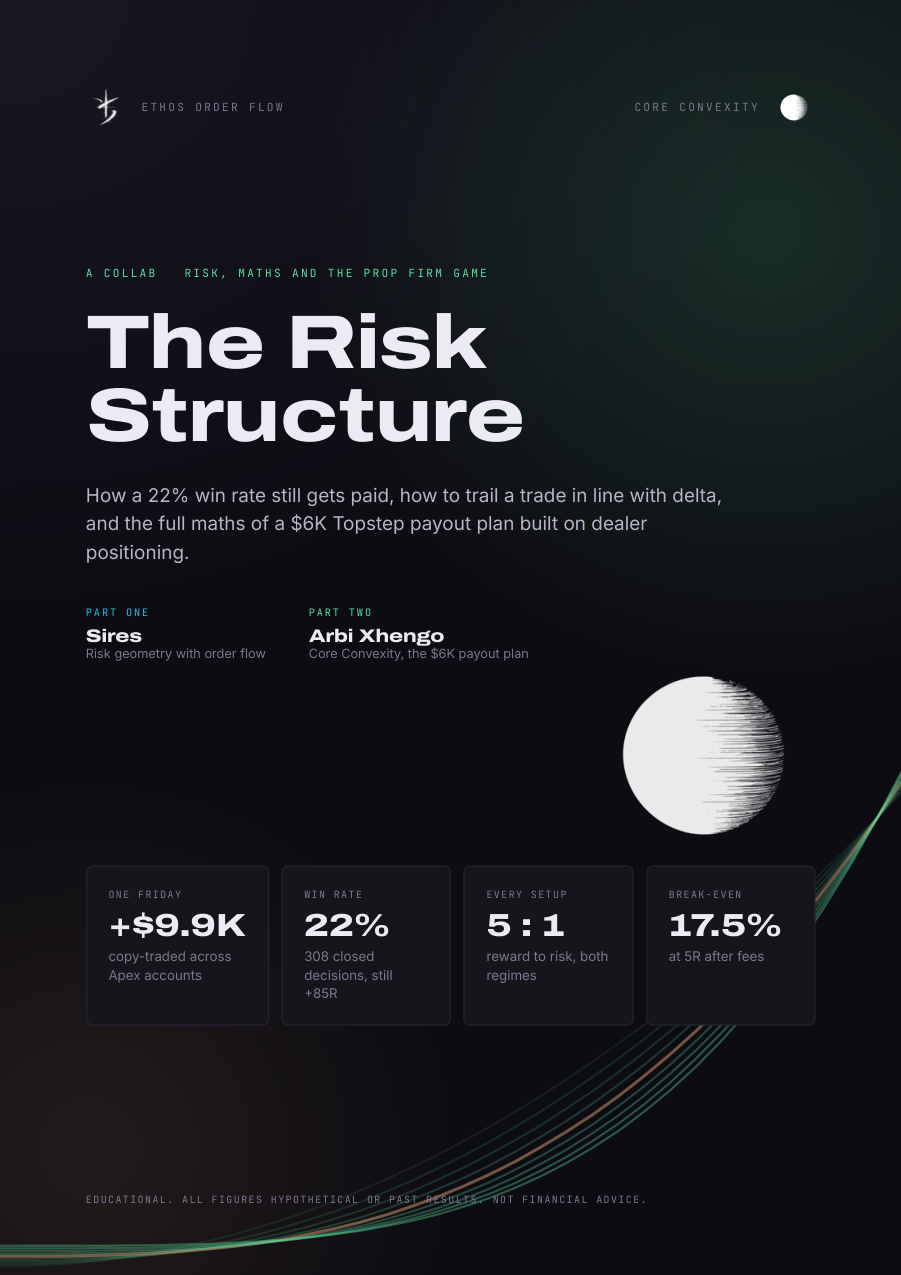
This is the companion to the collab between Sires and Arbi Xhengo, co-founder of Core Convexity. Both start from the same place: most traders do not lose prop accounts because of their entries, they lose them because of how they size and manage risk. Part one is Sires' risk geometry. A prop edge only has to hold for about two weeks, so variance is everything, and a 22% win rate with a 5.28 payoff across 308 closed decisions still finished at +85.27R and two max payouts in about eight days. The method behind it is trailing in line with the delta structure: out the moment the other side is rewarded, trailed while your side keeps winning.
Part two is Xhengo's $6K payout plan for one Topstep 50K account. A three-layer funnel decides whether to trade and how: macro, then dealer positioning (the gamma flip, open interest clusters, delta exposure and the vol surface, read on the Core Convexity terminal), then an order-flow trigger at the level. Two setups both pay 5 to 1 with size set by the regime, a ladder sized backwards from Topstep's rules, six non-negotiable session rules, the path to the first $6,000 request, and what 20,000 simulated funded months say about how often a month hits the max. Every number is shown with its assumptions.
The video this comes from
How a 22% Win Rate Gets Max Payouts
Watch the video for the live walkthrough. The PDF is the same material structured for study, with every chart and level labelled.
Inside the PDF
- Two traders, one idea
- $9,924.30 in one day
- Variance is everything
- A 22% win rate that gets paid
- Trailing in line with delta
- Static risk against dynamic risk
- The $6K payout plan
- The box you trade inside
- Context, then structure, then trigger
- The six steps, macro to trigger
- Size follows the regime
- The ladder and six rules
- $15K before the first request
- 20,000 simulated months
- What has to be true
Enter your email, the PDF downloads instantly.